







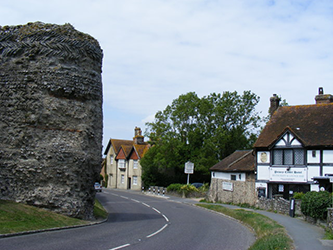
First the Saxons, then the Romans, then 1066 and all that, then St. Nicolas Church and the Diocese Of Chichester, the Elizabethans and the Cinque Ports, the smugglers, then the coming of the railway and the traditional bucket and spade seaside charm of near neighbour Pevensey Bay. It is the kind of history that Disney cannot match.
Sadly though, somewhere in the middle reel of this most savage of recessions, once proud little Pevensey appeared to be falling by the wayside.
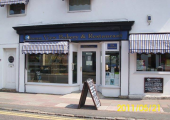
The Old Mint, dating from the 16th Century, closed as a visitor attraction. With it went an antiques emporium and other shops, along with the Post Office, and of course there was the dereliction of the Priory Court Hotel, the eyesore (until recently) facing the castle.
The other tea rooms, nestled next to the castle, owned by English Heritage, closed five years ago. Once upon a summer’s day there was a restaurant, tea rooms, and a garden filled with the laughter of families enjoying a special day out in the locality, from as far afield as Germany, Japan and Australia.
It remains something of a public scandal. The late Edwardian building is now rotting in front of our eyes like a forgotten great aunt.
For the last few years, the High Street has become somewhat poorly, so much of the decay seemed to rest on news of what would happen with the locally loved Priory Court Hotel. Wakes and weddings. Many people have memories of time spent at special occasions that they treasure.
Two local public houses, straddled either side of the road do brisk trade, but of course for many visitors, particularly those with families, it is not always their first choice as a place to take people for a gathering, when they have come all this way to see, enjoy and study the place that Michael Wood in his seminal BBC series ‘The Great British Story – A People’s History’ described as ‘the place where the story began’.
On cold October days, the High Street in Pevensey came to look like Desolation Row.
It is an image, passed down through history, that became a talking point.
The spot that marks the place where five of the citizens of the borough left to sign the Magna Carta in 1215 has become a deserted car park.
The Castle can also appear to be closed for business.
The very able and experienced staff who manage the affairs of English Heritage from inside the grounds in their ‘hut’, are hard pressed to answer the criticism that one of the key castles in the history of this country is represented by three paragraphs on the back of a leaflet about a different location.
How did it come to this state of affairs, historians began to ask?
The arrival back of the Priory Court tea rooms marks a sea change in the fortunes of the village.
It heralds the possibility of the start of some kind of regeneration and the tantalising prospect of the village returning to its rightful place on the history map of this country.
So how was the day of launch?
Saturday 1 March saw the return of some hope, even better, given all the hullabaloo over the High Street, without pomp or circumstance.
The tea rooms is comprised of two adjoining spaces that formed the original structure of the building when it was built circa 1660.
Not too showy, not twee, just traditional, with a good mix of treats is the best description. Perfect for a family wanting to make a visit as part of their big day out.
The price range is right, without the need to pay a premium because there is a National Trust or English Heritage label on the teapot.
Paninis for £4.00 were delivered out of the kitchen through the morning. Crisp and tasty with small salads. Just the ticket.
The tea was fresh and served by the pot and the special cream teas came with an ample tub.
The food was excellent. Samantha, who served, was spot on. She is also responsible for the social media feed that comes from the enterprise on a daily basis, and as with her serving skills, she is a natural communicator and her approach is already paying dividends.
A snatched conversation with Liz, the proprietor, was informative.
Through the casement windows, albeit cut by the traffic flow, is direct sight of the Castle.
The Eastern Gate, the place described by Kipling in Puck of Pook’s Hill as the imaginary ‘England’s Gate’ is fifty yards away from the Priory Court Tea Rooms. That will go down well with the literature buffs and their Guardians amongst the taking of tea and ices.
Outside, the ‘patio area’ has been well planned, with steps down to the door as its own gateway and simple tubs of flowers acting as spotters.
Looking through the attractive window, my attention was caught by a particular feature, that by all accounts has not been a focus for the team behind the launch. I made a note in the margin.
Maybe serendipity, with some magic, history and literature in the mix, have all come together to light the path of the Priory Court Hotel.
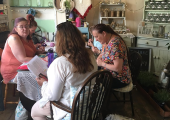
The place filled at mid-day with families dropping in to support and celebrate the launch with Liz and her able staff, so I decanted to the patio outside and enjoyed the first rays of Spring sun.
Distracted again by the extraordinary co-incidence of what was there right in front of me, I put the thought to one side a second time, whilst I began to jot down a few thoughts about what to say with regard to the tea rooms.
Any criticisms?
None that matter, but if wanted to be picky I would say that what a real Sussex Cream Tea needs is ‘Made in Sussex’ cream, rather than the equally good Cornish variety, but it seems more than a touch churlish to mention it. Just a thought. Perhaps price is the issue. It would go down well though with visitors from overseas. It is the kind of thing that they notice.
Any other criticisms?
First day out of the hatch is possibly not the time to mention that there is no history.
With such a rich mix from which to draw sources (including of course the building itself), it would be nice to see something documented on the walls as a set of feature based assets. Visitors would love it.
If they have come to see the Castle, then they have also come to see the Priory Court Hotel and a description of its history, particularly with regard to the tea rooms, would be a perfect starter.
No doubt this will come, and all in good time.
Liz was kind enough to come out in the middle of the big day, to continue a conversation we had started in the tea rooms before it got busy.
Something really had caught my attention and I returned for the third time to what was standing there right in front of me, waiting to take its place on the stage as part of the proceedings.
There, before me, was a grand reproduction old London street lamp.
Did she know anything about the lovely old piece of street furniture, I asked?
‘No’ she said, ‘it was left here by the previous owners and we just kept it’.
My mind switched to C.S Lewis and the Chronicles of Narnia and the lightbulb went on.
The academics cannot agree about the origin of the wardrobe in the famous series of children’s books that forms the gateway to the magical world of Narnia.
In the third book of the Narnia Chronicles, the family name of Edward, Peter and Lucy is mentioned for the first time, the name is Pevensie. The choice of name was not an accident.
The famous wardrobe in the Narnia Chronicles, according to some academics, who have researched the life and works of the author, is modelled on the notion of a ‘gateway’ to a magical world, a notion that comes from the work on another author, Rottingdean based, Rudyard Kipling.
In Puck of Pook’s Hill the Eastern Gate at Pevensey Castle becomes ‘England’s Gate’ Does the idea behind the wardrobe therefore derive from the Eastern Gate at Pevensey Castle?
It seems quite likely, when you put the pieces of the jigsaw together. We have the wardrobe, and the name of Pevensie for the family. It all starts to fit does it not?
Of course, we will never know for sure.
With or without The Lion, The Witch and the Wardrobe, are we looking at the start of a revival in the fortunes of the famous village?
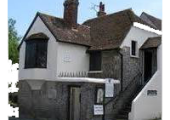
The old Gaol and Museum in the High Street open their doors again at Easter.
The public houses are doing good trade.
The re-investment of English Heritage in the Castle has already been documented as a set of intentions publicly, by ex chair Baroness Kaye Andrews.
Their windfall from the Government (£83 million) is yet to be dispersed as a result of their change of status and request to become a registered charity.
Some of those dividends, we know, will come to Pevensey Castle and work within the locality.
A new scene, that started with the storyboard entrance of the village as ‘Pevensae’ on the Bayeux Tapestry, created by Kent weavers around 1081, would appear ready to begin.
The tablecloths look lovely. Tea in a wonderful 17th century setting, overlooking the Castle, suites of rooms being readied, function rooms for special occasions being booked, receptions and weddings being planned.
Many congratulations to the local family that has worked so hard to see the Priory Court Hotel and Tea Rooms restored to business. It has been a long hard labour of love over more than two years.
So much is resting on the future wellbeing of the business for the locality, that it behoves us all not just to browse this new chapter, but to become immersed in the story as it develops.
We are such stuff as dreams are made on.
In the Lion, the Witch and the Wardrobe, the sight of an old London street lamp is the first thing that we witness, as the world of Narnia opens to the imagination.
Given the Narnia Chronicles references in the locality, it is an extraordinary coincidence that the path to the patio at the Priory Court Tea rooms is lit by an old London street lamp, is it not? Will this lead to good blessings? Perhaps we should leave the last word to Lucy.
A big welcome back to the Priory Court Hotel Tea Rooms.
Very best of luck with the enterprise that means so much, not just to the promotion of the unique history of the village, but also to its future.
“It will not go out of my mind that if we pass this post and lantern, either we shall find strange adventures or else some great changes of our fortunes.”
―Lucy Pevensie, opening chapter, The Lion, The Witch and the Wardrobe, C.S. Lewis.
Simon Montgomery
editor, Bay Life
all rights reserved.