











News has broken that works are to begin at Peveney Castle—Bay Life, 23 February 2016
Talking today to Bay Life (23 February), clerk to Pevensey Council, Malcolm Lawson, pointed us towards the new council social media page for the news.
The new social media feed is working wonders with profile and communication. Pevensey Parish Council can now talk directly to the community.
Malcolm explains, “Good news from English Heritage! As part of a programme of works that are planned to tackle conservation and maintenance issues the North Tower is to be drained and there will be repairs replacement to the exterior staircase.
“There is a lot to happen before the bottom part of the tower can be fully opened but this is an important step and a very welcome development”.
He adds that disruption to pedestrians and dog walkers should be minimal, “there will be some tracking going down in the Outer Bailey this week as it is necessary to protect the ground from heavy vehicles in the wet conditions. Disruption to pedestrians, dog walkers and so on will be kept to a minimum so there should not be any issues but if there are any concerns call the number on the guardianship panel at the entrance to the site : 0370 333 1181″.
The profiling of the castle has been the subject of much discussion locally over the last few years, particularly with regard to what has happened with the Castle Cottage Tea Rooms that adjoin the castle.
The news that there is now a programme of works commencing at the castle is welcome. There is no official news about the future of the Castle Cottage Tea Rooms.
The Castle Cottage Tea Rooms is the first building that people see as they arrive in Pevensey, brought to the Cattle Market Car Park by coaches from across the world.
Facing them is seven years bad faith and dereliction.
When the most popular and well regarded historian in the country, Michael Wood, wrote his groundbreaking BBC2 series, ‘The Great British Story: A People’s History”, it was to Pevensey that he turned to begin his story. Directly to camera he started with these words, “this is where it all began”.
With regard to the Castle Cottage Tea Rooms, you could not make the story up could you?
We have been told the same story so many times, over so many years. Something is to happen with the Tea Rooms. There is a lot of interest in there being a new leaseholder. We have been told the same story so many times, we have stopped listening, have we not?
“From small beginnings,” says English Heritage, “towards the end of the 19th century, the collection of historic places now managed by English Heritage has grown to over 400, inspired by a determination to put England’s heritage ahead of private interest.
“In 2011, for the first time, the national heritage collection made an operational surplus. In other words, instead of costing money to open it to the public, a small surplus was made.
“Thanks to these successes the government agreed that it would provide £80m to English Heritage if it transferred the national heritage collection to a charitable trust.
“This happened on 1 April 2015 when the old English Heritage separated into two parts: a charity that looks after the collections, and Historic England that champions the nation’s wider heritage, running the listing system, dealing with planning matters and giving grants”.
The money we are seeing being spent on Pevensey Castle is a proportion of this £80 million.
The brilliant Kate Mavor is the Chief Executive of English Heritage. By all accounts she did more than turn around the National Trust for Scotland as part of her tenure as the Chief Executive.
English Heritage says she, “arrived at a moment of financial crisis for the Trust. During her tenure there, she was instrumental in transforming the charity’s fortunes, introducing a five-year-plan to restore its financial stability and giving it a new sense of purpose”.
Her new role is the third major challenge she has taken on in a key position with regard to the management of the heritage of the country. She is noted for her ability to steer charities through tough financial periods and she is particularly versed in issues involving constitutional change and staff restructures.
She has been briefed to make English Heritage self-funding in eight years and she is financed by the £80m government grant.
She says,”It is a privilege to lead English Heritage on the first stage of its new journey as a charity. English Heritage looks after sites where momentous historic events took place. Individually and collectively these precious places tell a remarkable story.”
The remarkable story, as the historian Michael Wood pointed out, started here.
If English Heritage can not work out how to make the Castle Cottage Tea Rooms work in Pevensey then the tea stain will stay with them until they do.
In the Age of Austerity we do know that some things work. History works, because English Heritage has told us that it works. By their own account, in 2011, for the first time, the national heritage collection made an operational surplus.
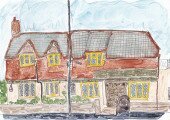
Tea Rooms, particularly tea rooms with a genuine historic and nostalgic sense, work. How historic do you have to get with the Castle Cottage Tea Rooms? The building is bathed in what appears to be faded Edwardian glory. The building is attached to a castle that is nearly 2,000 years old.
Let us hope, that as well as the announcement that we are to see a programme of works begun in the next few weeks at Pevensey Castle, that what will follow is a further announcement about the Castle Cottage Tea Rooms and what will be done.
Schools in coaches arrive from across the country. Visitors arrive in coaches from places like Germany and Japan.
The first point of public contact that some of these people experience with the preservation and protection of our precious heritage, in terms of services and facilities in this country, is a building that has been left to rot for seven years.
What does that say about English Heritage? What does that say about how much we value our history and the way in which we provide services for people to experience our history from public funds?
What does that say about us as a community that we have not been more vociferous in our view of the situation?
What has been allowed to happen at the Castle Cottage Tea Rooms is a public disgrace. Now is time to put the matter right.
By all accounts, Kate Mavor, the new Chief Executive of English Heritage is a dynamic person. Perhaps she is the person to put things right.
She explains that her focus is on places where “momentous historic events took place”. Does not Pevensey Castle with a 2,000 year history and the focus of five major sieges at key points in history, qualify for further consideration?
Her predecessor as the Chief Executive of English Heritage, Dr. Simon Thurley, made much of the need to modernise and contextualise the services that feed the ‘history experience’ as people ‘Step into England’s Story”.
This vision is still work in progress at Pevensey Castle. At the place where, as Michael Wood explains, you really do ‘Step into England’s Story”, English Heritage does not even provide a toilet.
Many of the arguments being put forward by English Heritage are about the need to sustain the current portfolio of properties and not make any acquisitions. The business case for each property needs to be put effectively. Here we have a property that English Heritage already owns. The business case for the building as tea rooms is credible.
The castle is precious. In the preservation of our identity as a community, and in relation to our economic and social wellbeing, the Castle Cottage Tea Rooms is also precious.
There is a great deal of good within the community. Local businesses, stakeholders, organisations, authorities and residents are working hard to see that the fortunes of the locality are restored and much is happening.
Grants, lottery funding, economic initiatives, plans and small scale entrepreneurial and economic initiatives are making a difference to the area, in ways that are of demonstrable and sustainable value.
What happens with the Castle Cottage Tea Rooms is pivotal to our profile as a visitor destination.
Credit to English Heritage for keeping the community informed about the programme of works that is about to begin.
Credit also to Pevensey Parish Council with their new social media feed. They are keeping us informed on a weekly basis of what matters with issues, plans, developments and events in the local community, in a way that is an example of best practice.
Simon Montgomery
editor, Bay Life