












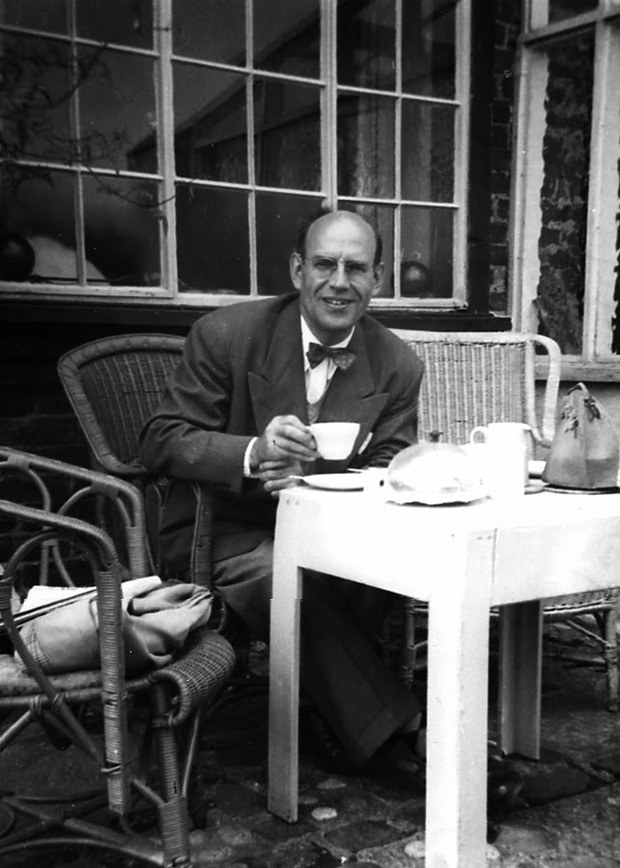
image credit: Allen Walker Read having tea at “The Honeypot”, Pevensey Bay, England, July 11, 1954. Photograph by Charlotte Schuchardt Read. IGS Archives.
The Wealden District Council planning application portal today has an application lodged to demolish the building and turn the location into eight flats., by the owners, Foss Holdings, based in Reigate. We wait to see what Wealden Council will make of the application, which would see a loved character building that has been part of the economic fabric of the locality for as long as people can remember, demolished and removed from the life of the Bay, both for residents and visitors.—Bay Life, 14 February 2017
Application number :WD/2017/0060/F
BEACH TAVERN, SEA ROAD, PEVENSEY BAY, BN24 6EH
Proposal: 7 NO. 2 BEDROOM APARTMENTS, 1 NO. 1 BEDROOM APARTMENT AND ASSOCIATED ACCESS AND PARKING FOLLOWING DEMOLITION OF EXISTING PUB.
. . .
The loss to Pevensey Bay of a key economic location in a character building of note that is a something of a focal point in the village, will be seen as being of significance to some residents and businesses.
Pevensey Bay is facing a time of critical need with local business. The fragile base for business, faced with yet another blow in relation to the loss of a key business location will be seen in some quarters as detrimental to the future of Pevensey Bay as both a visitor destination and a place of unique note.
In some ways, the character of the building and history are representative of something essential about Pevensey Bay.
Critical questions about regeneration are being considered by all local authorities. In small coastal locations like Pevensey Bay, these questions become hypercritical. Some small coastal locations are building on their unique properties with new kinds of business activity, some are falling by the wayside.
There is a desperate need to see rural businesses survive. in particular in small coastal locations like Pevensey Bay, there is a desperate need for local businesses and new businesses to find ways in which they can regenerate themselves.
A business building lost of this nature, once demolished, does not return. There is a kind of domino effect felt by all the local businesses.
Any new business considering relocation to Pevensey Bay is unlikely to be encouraged today by sight of the application.
There is something of an irony involved in the timing.
Up the road, the Sovereign Harbour Business Park, as it is now being called, is about to see millions invested in the infrastructure. The opportunity for Pevensey Bay to benefit from this huge growth in development is manifest.
On a small satellite basis, are we about to see some new small retail or business units established in Pevensey Bay as part of this growth?
Where better for these kinds of small retail or service based unit than on the ground floor of the character building that is the Beach Tavern, once called the Honeypot Tea Rooms?
If we lose more businesses in the Bay, particularly service based businesses, we lose something of the spirit of Pevensey Bay.
It could be argued that the loss of the Beach Tavern, in such a cornerstone location, as a viable economic unit or set of units, is a loss that could become some kind of tipping point.
The death of the 200 year old story of Pevensey Bay as a visitor destination, which began with horse and cart rides to the location, from Eastbourne, recorded as early as 1814, is much exaggerated.
Nonetheless in some small way the news today has brought into sharp relief more questions about the future of Pevensey Bay as a visitor destination.
Simon Montgomery
editor, Bay Life
image credit: Allen Walker Read having tea at “The Honeypot”, Pevensey Bay, England, July 11, 1954. Photograph by Charlotte Schuchardt Read. IGS Archives.
source: Korzybski Files: The Life, Times, and Work of Alfred Korzybski with Non-Aristotelian Sightings and Comments on the Passing Scene. Chapter 52 – “Recognition But Very Little Money”: Part 4 – “Do You See Red?”
. . .
UPDATE: 15 February: Residents comment
Comments began to come in to Bay Life from local residents within minutes of the publication of this article.
Jan Barron commented, “So much for the idea that the new owner wants to attract local small businesses. Can objections be made to the council to prevent the planning permission being granted?”.
The sentiments were shared by many people.
Jan Whiting said “The powers that be won’t be happy until the villages and countryside is tarmaced, the only way they can make their money. Resist! Keep your environment pleasant.
Daisy D’arcy was succinct, “because we need another 8 flats in the bay!! disgrace”
Questions over the local library emerged again. Karen Armitage said, “No no and no again I know I keep saying it we don’t need flats we need the library to be moved to the Beach Tavern it’s ridiculous where it is can nobody see that there’s enough flats in the bay there has been 2 lots converted recently”.
With regard to questions about the character of the village, Corrine Morgan summed up the feelings of a number of residents, “I hope that gets kicked out of planning”.
Local resident, Helen Brown, perhaps spoke most strongly to the news with a question, “The building is old but I do think I know when it was built. Shame they pull down the property with character. …… just for monetary gain nothing else considered then build a monstrosity like a cell block H . There is still one new flat not sold where the newsagents was. I wonder why?”
Owners of the building, Foss Holdings, based in Reigate, were invited to respond to this article. Ray Foss on behalf of Foss Holdings, issued Bay Life the following response (February 16), ”
UPDATE: 16 February: Owners of Beach tavern site, Foss Holdings, respond
Foss Holdings, statement to Bay Life, 16 February 2017
The Beach Tavern was originally the Honeypot Tea Rooms, but had to close due to lack of support from both residents/visitors.It then became the Beach Tavern and again had to close due to lack of support from the community and under dubious circumstances (Facebook October 2015) by all accounts not the sort of place you would like your families/friends to frequent.
The local community tried and failed to obtain the support to re-open it as a library in 2016
The community surely don’t want this eyesore left standing as a blot on the landscape in the centre of the village, for visitors to see
The flats that we are proposing are high end and would encourage at the very least a better visual impact for both residents and visitors alike.
—Ray Foss, on behalf of Foss Holdings, 16 February 2017
image credit: Allen Walker Read having tea at “The Honeypot”, Pevensey Bay, England, July 11, 1954. Photograph by Charlotte Schuchardt Read. IGS Archives.
about Allen Walker Read, etymologist, died on October 16th, aged 96 Oct 24th 2002
FOR much of his long career studying language Allen Read sought the origin of OK, perhaps the most useful expression of universal communication yet devised.
You can use OK not simply to indicate agreement but, with appropriate facial expressions, shades of agreement, even disagreement. It is a vocabulary in itself. No wonder that OK has found its way into nearly every language in every country, and beyond. It was the fourth word, if you can call it that, heard on the moon, spoken by Buzz Aldrin. For etymologists, establishing the origin of OK became something of an obsession, equivalent to mathematicians’ long quest for the proof to Fermat’s last theorem.
For years Americans assumed that OK must be of American origin, if only because it was so successful. Some doubt about this claim arose in the second world war when American soldiers discovered that OK was already familiar in other countries; in Britain, of course, but in Japan and even (according to H.L. Mencken, an American writer on language) among the Bedouin in the Sahara.
Some linguists suggested that OK was of European origin. After all, the Europeans had been knocking around the world long before Americans got on to the scene. Germans said it was the initials of the fiercely-sounding rank of Oberst Kommandant. The French put in a claim for Aux Cayes, a town they had established in Haiti that produced superior rum. A British scholar said the use of OK in Britain predated any American influence and had probably come from Elizabethan English. Things were getting serious in the world of etymology. Step forward the Americans’ champion, Allen Walker Read.
In his hunt for the origin of OK he was offered dozens of theories. The first to go were the European ones. They were appealing: Mr Read liked what he called “frolicsome” ideas. But they had no substance, he said. He was convinced that OK was American. He warmed to the idea that the popularity of Orrin Kendall biscuits, supplied to soldiers on the Union side in the civil war, had lived on as OK. He noted there was a telegraph term known as Open Key. But OK proved to have been used much earlier. Writing in American Speech in 1963, Mr Read said that he had come across it in the Boston Morning Post in 1839. In what was apparently a satirical article about bad spelling it stood for “Oll Korrect”. The next stage in OK’s popularity was when it was adopted by followers of Martin Van Buren, who in 1836 became the eighth president of the United States, and unsuccessfully stood for re-election in 1840, by which time he was widely known as Old Kinderhook, a nickname he derived from his home town. “Vote for OK” was snappier than using his Dutch name.
Mr Read showed how, stage by stage, OK was spread throughout North America and the world to the moon, and then took on its new form AOK, first used by space people and frowned on by purists. This being an exercise in the academic world, there remain some doubters. Some believe that the Boston newspaper’s reference to OK may not be the earliest. Some are attracted to the claim that it is of American-Indian origin. There is an Indian word, okeh, used as an affirmative reply to a question. Mr Read treated such doubting calmly. “Nothing is absolute,” he once wrote, “nothing is forever.”
Source: Allen Walker Read – The Economist
www.economist.com/node/1403400
24 Oct 2002