










Easter Day Acts 10.34-43 Colossians 3.1-4 John 20.1-18
A late Easter presents many aspects of beauty, the burst of summer weather that we have just experienced being one of them. There are bees in the garden, the smell of newly mown grass is commonplace, and the trees are in blossom.
The image of a garden is distinctively associated with John’s gospel. It is the location of the betrayal of Jesus (John 18.1) and of his burial (John 19.41), setting the scene for today’s encounter with Mary Magdalen when she mistakes him for the gardener.
John wrote his gospel in Greek. Another Greek word for ‘garden’ is paradeisos. This word that we translate as paradise and is used in Genesis to describe the Garden of Eden. The word originates in the area that we now think of as Saudi Arabia, Ethiopia and the Sudan.
In these hot and arid places, the luxury of a ‘paradise’ around your house was a sign of incredible wealth, as it still is today. The ‘paradise’ was generally an ornamental setting for a large house, scented by herbs.
Perhaps this begins to explain why one of the accounts of creation in the book of Genesis uses the paradise garden as a way of imagining the incredibly beautiful environment in which God lives. But as we know, the author of this bit of Genesis also locates spectacular disobedience and betrayal by Adam and Eve as taking place in the paradise of God.
The idea of paradise as someone’s garden and a part of their home can help us to see ourselves as honoured guests there. It deepens the sense that we are still caught up in the drama of this ancient narrative. Through our own wilful folly, we human beings make a terrible mess of this experience of gracious, generous hospitality. And herein lies our shame.
The shame of Adam and Eve rests not, actually, in their nakedness. Their shame and ours lie in the betrayal of trust, the misuse of someone’s garden and abandonment of an honoured place in someone’s home. The experience of mortality and death that follows is the self-inflicted consequence of separation from God.
Why should any of this matter on Easter Day?
The encounter in a garden between Mary Magdalen and Jesus imaginatively re-connects us with the book of Genesis, which is an incomplete story about the loss of paradise. Today’s gospel, however, turns the narrative of human experience towards a new conclusion. Here is the beginning of a final chapter in which our shame is dispelled by recognition, purpose and delight and earth becomes a new kind of space, replete with the presence of God.
The matter is put simply and eloquently by an English gentleman-scholar, Edwyn Hoskyns, who devoted much of his life to studying the gospels, especially St John’s Gospel. He imagines Jesus as the Lord of the garden, as described in Genesis: “and once more he walks in the garden in the cool of the day, the early morning, and converses not with the fallen, but with the redeemed.” Mary Magdalen is recognised by Jesus, known by name as a sign of her dignity, and her life given purpose through the privilege of sharing her experience with others. “I have seen the Lord” (John 20.18) is a statement of delight as well as a mission slogan.
Not everyone has taken seriously the interpretation that Hoskyns suggests. And I suppose there is a danger here that we could begin to imagine the resurrection as the concluding episode to a costume drama set on the broad lawns of a large Edwardian mansion. But that would be to mistake the seriousness of the man.
In the four years between 1908 and 1912, Hoskyns served as a curate in a tough, working-class parish in Sunderland. In 1915 he signed up as an army chaplain in the First World War, was injured, mentioned in dispatches and awarded the Military Cross. As a result of those injuries, he died young, in 1937, aged 52.
Hoskyns wrote his observation about the encounter between Mary Magdalen and Jesus in 1920. The scars of atrocious suffering and death were still newly imprinted on his mind and body, as they were on the British nation and Europe generally. No celebration of the resurrection could make glib, simplistic claims that left the fields of Flanders unaccounted for. Hoskyns had to work hard to believe and to proclaim that “the fallen” are also the redeemed.
Different challenges face us now as we continue to dare to make the astonishing claim that Jesus Christ is risen from the dead. The fallen are known to us globally as victims of poverty, disease and injustice, or specifically as child soldiers in Africa, victims of nuclear contamination in Japan, and those without employment who represent our inequalities at home.
On Easter Day we assert that the fallen are also the redeemed. Each and every one of them, of us, was made for a place in God’s paradise. Through the glory of resurrection, God invites us back into the dignity of life as an experience of divine perfection.
Life in paradise is not fiction, it’s a challenge. Here is the invitation to mend our manners and learn to live differently, shaping this garden, the earth, into a reflection of paradise. Here we learn that scars can be the promises of glory.
Here is news for sharing. Allelluia!
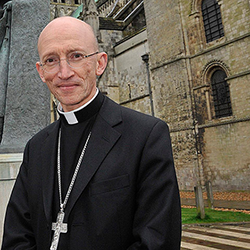
The Bishop of Chichester is the ordinary of the Church of England Diocese of Chichester in the Province of Canterbury. The diocese covers the counties of East and West Sussex. The see is based in the City of Chichester where the bishop’s seat is located at the Cathedral Church of the Holy Trinity. On 3 May 2012 the appointment was announced of Martin Warner, Bishop of Whitby, as the next Bishop of Chichester.[2] His enthronement took place on 25 November 2012 in Chichester Cathedral.